Membership Pricing Structure
Each membership level is based on how many systems are being protected, not how many perks are stacked. Homes don’t fail all at once. Systems interact. Coverage scales accordingly.
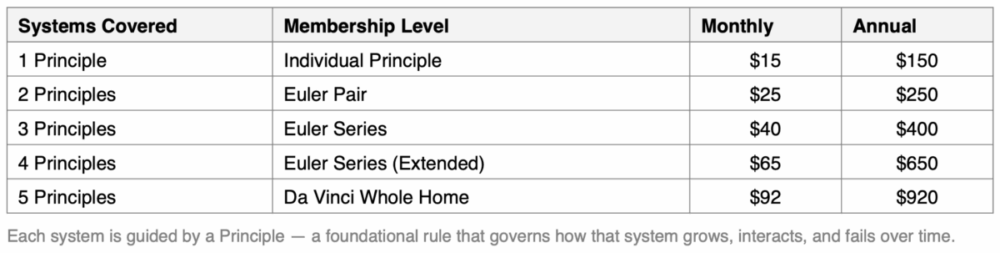
Monthly vs Annual Membership
Monthly membership provides flexibility and access. Annual membership represents alignment. When a homeowner commits annually, Axis Mechanical commits in return: planning ahead, prioritized scheduling, system familiarity, and intentional, preventive care. Annual pricing reflects shared responsibility. It is not a promotion.
The Integration Pinnacle — Da Vinci Whole Home
Leonardo da Vinci represents the unification of multiple disciplines into a single coherent whole. In the Fibonacci Membership, Da Vinci signifies the point where growth, relationships, and integration collapse into unified system stewardship.
Included at This Level
- Full evaluation of the home as a unified system.
- Two whole-home inspections per year to account for seasonal and structural change.
- Complete priority preventive care across all five Principles.
Brand Note — Alignment Before Discounts
Annual membership reflects alignment, not discounts. It represents commitment from both sides, allowing Axis Mechanical to plan ahead, prioritize service, and protect home systems intentionally instead of reactively. This alignment enables better timing, clearer oversight, and more consistent outcomes over time.
Pricing Philosophy & Mathematical Structure
The Fibonacci Membership is built on a simple belief: homes behave as systems. As systems grow and interact, complexity increases. Effective care follows structure, not shortcuts. Growth follows sequence. Relationships create balance. Integration creates resilience.
Pricing Structure Explained
The Fibonacci Membership is structured to grow proportionally as system coverage expands. As additional systems are protected, pricing increases in a measured way that reflects rising complexity and interaction. At the Da Vinci Whole Home level, the structure intentionally shifts. Rather than continuing simple growth, the focus becomes integration—treating the home as a unified system instead of a collection of parts. This transition is symbolized by √2, representing integration across axes rather than linear addition. The result is a pricing structure that reflects not just more coverage, but a fundamentally different level of responsibility and stewardship.
For the mathematically curious: in fluid mechanics, ideas such as Stokes’ Theorem describe how interior system behavior manifests at boundaries — a quiet parallel to why whole system understanding reduces inefficiency at the edges.
Precision Isn’t a Claim. It’s the Standard.